The 10:15 Window: Riding Mumbai’s Local Trains Like You Mean It
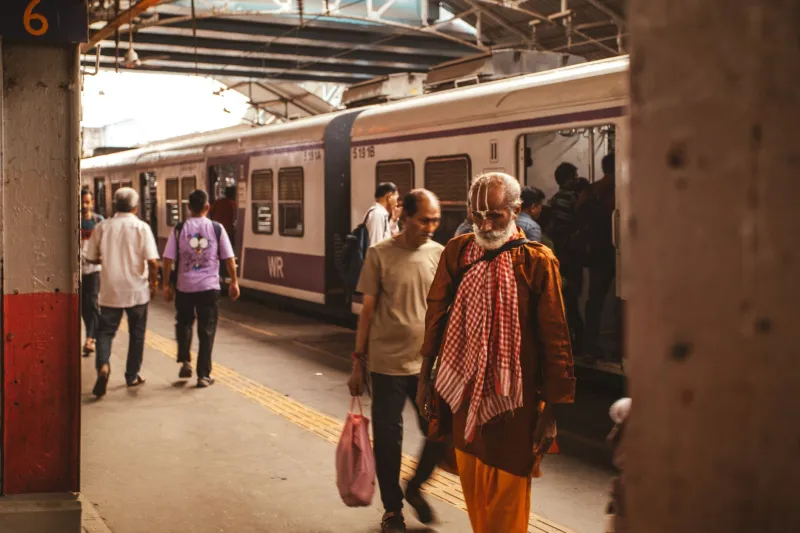
On a New York subway, you ride to get somewhere. On a Mumbai local, you ride through the city’s circulatory system. The trains are crowded, cheap, fast, and utterly central to how Mumbai works. They are also the closest thing the city has to a shared public living room—except everyone is standing, the doors are open, and the announcement just told you to mind the gap.
This is not a guide to romanticizing the crush. The crush is real, and it is not fun at 9 a.m. on a Monday. But if you time it right, a short ride on a Mumbai local is one of the best ways to understand the city. The train is the attraction. Here is how to ride it without getting in the way.
The Lines, in Plain English
Mumbai’s suburban network is usually talked about in three parts: the Western Line, the Central Line, and the Harbour Line. For a first visit, the Western Line is the easiest place to start. It runs from Churchgate in the south to the northern suburbs and beyond. The Central Line runs from Chhatrapati Shivaji Maharaj Terminus (CSMT) north through Dadar, Kurla, and beyond. The Harbour Line connects CSMT with the harbor side and the eastern suburbs.
Trains are marked “fast” or “slow.” Slow trains stop at every station. Fast trains skip smaller stops, which is great if you know where you are going and less great if you do not. Station codes are posted everywhere: Churchgate is CCG, Bandra is BA, Andheri is AD, Dadar Western is DDR, and Dadar Central is DR. Platforms can change without much warning, so listen for announcements and watch the boards.
Tickets: Paper, App, and Class
You need a ticket before you board. At major stations, buy from the counter or a ticket vending machine. The UTS app can work if you have an Indian mobile number and can set it up, but do not count on that as a tourist. Paper is simpler.
Second class is the cheap, crowded, everyday option. First class costs more and is usually less packed, though “less packed” is relative during rush hour. Buy the class you actually intend to ride. Keep your ticket until you exit—inspectors do appear, and “I threw it away” is not a winning argument.
If you have luggage, keep it close and avoid the doors. A backpack on your back in a crowded coach is a weapon. Wear it on your front or hold it low.
When to Ride (and When Not To)
Weekday rush hours are roughly 8 to 11 a.m. and 5 to 8 p.m. That is when the trains are fullest and the platforms are least forgiving. If you are a first-timer, do not test yourself at 9 a.m. on a Monday. Aim for the mid-morning window—around 10:15 to 11 a.m.—or the early afternoon. After 8 p.m. is also calmer. Sunday mornings can be surprisingly civilized.
During the monsoon, floors get slick and delays happen. Wear shoes with grip, keep your bag zipped, and give yourself extra time. If a train looks so full that people are hanging out of the doors, wait for the next one. There is always a next one.
The Rules That Keep You Welcome
Let passengers get off first. Stand behind the yellow line until the train stops. Move inside the coach instead of blocking the doorway. Do not film strangers without asking. Keep your voice low. Do not eat messy food. Offer your seat to older passengers, pregnant travelers, and anyone who clearly needs it, and respect the reserved seats.
If you are standing near the door, step out at your stop and then move aside so others can exit. Do not treat the doorway as a viewing deck. And if someone says “chalo” or gestures you inward, they are not being rude. They are trying to close the door.
Women’s Coaches, Explained
Most locals have women’s coaches, clearly marked on the platform and on the train. They are for women and children. If you are a man, do not enter them, even if the general coach looks awful. If you are a woman traveling alone, use them if you prefer; many women do. At night, sit in a coach with other passengers and keep your valuables zipped. Standard city safety rules apply: know your stop, keep your phone out of sight at the doors, and do not wander onto empty platforms late at night.
Short Stretches Worth Riding for the View
You do not need to ride end to end. Pick a short stretch and treat it like a city tour.
Churchgate to Bandra on the Western Line. A slow train gives you a cross-section of Mumbai—offices, stations, overpasses, apartment blocks, and the steady churn of commuters. It is not scenic in a postcard way. It is scenic in a “this is how the city actually works” way.
Mahim to Bandra on the Western Line. This is the creek-and-skyline stretch. Keep your camera low and your expectations realistic; the view changes with the light and the season. But when it works, it is a good reminder that Mumbai is a city built around water.
Reay Road to Dockyard Road on the Harbour Line. Industrial, salty, and full of port energy—cranes, containers, and the machinery of a city that moves goods for a living. It is not pretty. It is interesting.
A First Ride, Step by Step
Pick an off-peak window. Start at Churchgate. Buy a second-class ticket to Bandra. Follow the signs to the Western Line platform. Board a slow train. Stand near the door but leave room for people to move. Keep your bag in front of you. Get off at Bandra. Keep your ticket until you exit. That is it.
Do not overplan it. The point is not to collect a train ride like a badge. The point is to feel the city’s rhythm for twenty minutes and then step back out into it.
The Train Is the Attraction—Not a Roller Coaster
The local trains are not a dare. They are how nurses, students, office workers, vendors, and grandparents get through their day. Ride with that in mind. Be a good guest. Give people space. Do not complain about the crowd to the people who are in it every day.
If you do it right, you will get something better than a photo: a sense of how Mumbai moves, and why it moves so fast.