Letter by Letter: A Walking Tour of Mumbai's Vanishing Hand-Painted Signs
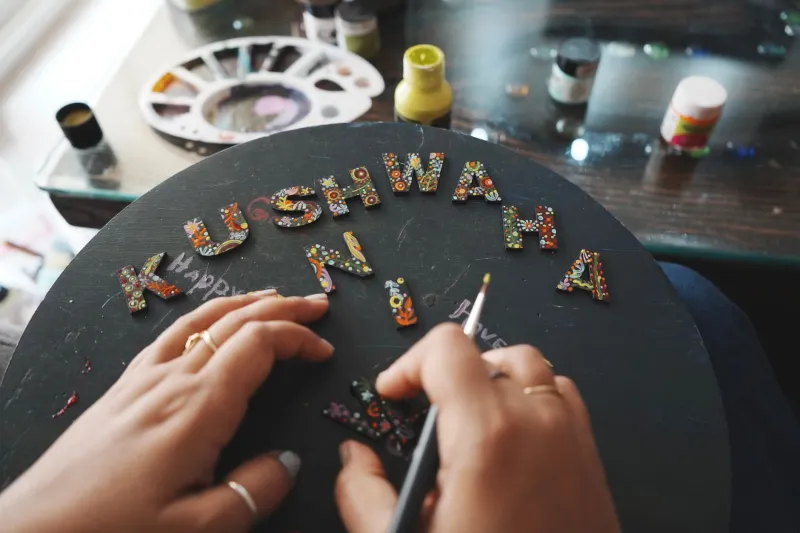
Mumbai is a city that looks best when you tilt your head up. Above the air-conditioning units and the tangled wires, above the plastic banners for mobile plans, there is another city: a city of hand-painted shopfronts. The letters are uneven. The shadows are brushed in. The colors—turmeric yellow, post-office red, a green that looks mixed from pond water—are mixed by eye, not by Pantone.
These signs are not nostalgia for nostalgia's sake. They are working infrastructure. A paan stall, a fabric shop, a dentist's office, a stationery bhandar: each one announces itself in paint. And as of 2026, the people who make them are fewer than they used to be. Which is exactly why you should walk this route now, while the paint is still wet.
The Painters Who Still Work in Public
A hand-painted sign is a small public performance. The painter has to know the shopkeeper's name, the shop's name, the goods sold, and the local language—sometimes all three languages of the street: Marathi, Hindi, and English. He has to fit it into a rectangle above a door, between a drainpipe and a religious calendar. He has to make it legible from across a crowded road.
On Kalbadevi Road one recent morning, I watched a painter in his sixties work on a cloth shop's board. He had a turpentine rag in one hand and a brush in the other. 'The computer gives you the same letters every time,' he said, not looking up. 'By hand, the letter has a mood. The customer wants the mood.'
That is the thing to understand before you start pointing your camera. The sign is not a mural. It is a transaction. The painter is often working on a ladder in the middle of a working street, and the shopkeeper is watching both the paint and the clock. Treat the scene like a small business, because it is.
How to Read a Shopfront
You do not need to read Devanagari fluently to enjoy the signs, but a little pattern recognition goes a long way. Look for repeated endings. भांडार (bhandar) means store or provisions—you will see it on stationery shops and dry-goods shops. वस्त्रालय (vastralay) is a clothing store. औषधालय (aushadhalay) is a pharmacy. मिष्टान्न (mishtann) points to sweets. चाय (chai) is tea, and हॉटेल (hotel) in this context usually means a small restaurant, not a place to sleep.
English lettering has its own grammar. A good old sign might use a serif so sharp it could cut paper, a drop shadow painted two inches to the right, and an ampersand that looks like a knot. Newer signs often use a stencil or a vinyl cutout. The hand-painted ones are the ones with tiny inconsistencies: a letter that leans, a border that thickens at the corner, a phone number that was updated by hand in a different shade of black.
Look above eye level. Look at the side of the building, not just the front. Look for signs that have been repainted in sections—the shop name in 1990s blue, the phone number in 2000s red, the 'UPI accepted' sticker slapped on later. That layering is the visual texture of Mumbai. It is also a kind of archive.
The Route: Fort to Kalbadevi
Start at Horniman Circle in Fort, early, before the offices open. Walk the arcade and look at the old bank and newspaper buildings—not for hand-painted signs, but for the scale of the streets you are about to leave. Then head north on Perin Nariman Street and Mumbai Samachar Marg, where the sidewalks are narrow and the buildings are tall enough to keep the morning shadow on your side.
Cross to D.N. Road and walk toward Crawford Market. This is the transition zone: corporate signage above, old shopfronts at street level. Turn into Kalbadevi Road and slow down. The signs get denser here. Fabric shops, wholesale hardware, spice sellers, small temples tucked between commercial buildings. Look for painted boards that advertise 'wholesale and retail' in English and Marathi, with a hand-drawn pair of scissors or a bolt of cloth.
From Kalbadevi, wander toward Bhuleshwar. The lanes get tighter, the signs get older, and the chances of seeing a painter at work go up. This is not a museum route. It is a working neighborhood. If you see a ladder and a bucket, you have found the good stuff. The whole walk is about two and a half miles, but budget three hours—not because the distance is long, but because you will stop every fifty feet.
Photographing the Signs Without Being a Jerk
Here is the short version: ask first, buy something, and do not block the sidewalk.
A shopkeeper in Mumbai is used to being photographed, but that does not mean he wants a stranger's lens in his doorway at 8 a.m. If the shop is open, step in, point at the sign, and ask, 'Photo?' Most people will nod. If they shake their head or wave you off, move on. Do not photograph people's faces without permission, especially in the older lanes where a camera can feel like surveillance. Do not use flash on wet paint. Do not lean on a ladder. Do not stand in the middle of a delivery route to get the perfect angle.
The best etiquette is the traveler's version of common sense: buy a packet of biscuits, a bar of soap, a cup of tea. You are not paying for the photo; you are participating in the street. And if you want to talk to a painter, wait until he pauses. Ask about the letters, not about 'the dying art.' He has heard that one before.
Sundays are quiet, which is good for clean shots and bad for seeing the neighborhood at work. Weekday mornings are best: the light is low, the shutters are up, and the street is doing its actual job.
If You Go
Wear shoes you can walk in. Carry water. Keep small bills for tea and snacks. Start by 8 a.m. in cool weather, or by 7:30 a.m. if you are here in the warmer months. The route is best done slowly, with no fixed lunch reservation and no expectation that every sign will still be there next year. That is the point. The city is repainting itself all the time. Your job is just to look up while the old letters are still legible.