Samosa at Intermission: A Crawl Through Mumbai's Surviving Single-Screen Cinemas
Ask anyone who grew up going to the pictures in Mumbai what they remember about a movie and you'll rarely get a plot. You'll get the samosa. The guy two rows down who sang along. The minute the lights came up and half the hall bolted for the concession counter like the building was on fire.
Multiplexes won most of the argument years ago, but the city still has a stubborn handful of single-screen cinemas holding on — big rooms with one screen, one show time, and one interval. Going to one in 2026 isn't nostalgia for its own sake. It's a different way of watching a movie: louder, warmer, cheaper, and considerably more social than anything you'll find in a mall.
The interval is the attraction
Here's the thing to understand before you buy a ticket: in an Indian single-screen hall, the interval isn't an interruption. It's a scheduled event, usually ten to fifteen minutes, announced by the film freezing mid-scene. The lights come up. Roughly a third of the audience stands immediately. Vendors work the aisles. Somebody's uncle is already at the counter ordering four samosas and a round of chai for a row that didn't ask for it.
The snack bar is a small economy of its own — samosas, vada pav, popcorn tossed with butter and a red masala, cold drinks in glass bottles, kulfi at the exit. Prices are low enough that you'll probably spend less on the food than on the ticket, which flips the American moviegoing math on its head.
Rules of the crawl
- Go to a matinee. Afternoon shows are cheaper, emptier, and the crowd is more relaxed.
- Call ahead or check listings the same day. Single screens swap shows fast and close for repairs without much notice. Build your plan around what's actually playing, not what's on a blog.
- Carry cash. Cards work in some counters, not others.
- Arrive early. The building is half the reason you came. Walk the lobby, look at the tile, the old posters, the ticket window.
- Don't leave at the interval. That's the whole point.
Maratha Mandir, Dadar: the endurance champion
This one is a landmark in the least fussy way possible — a big, plain, unapologetically functional hall a short walk from Dadar station, and for decades the kind of place where the same film could run for years rather than weeks. The crowd here is a proper cross-section of the city: families, couples, guys on a day off, everyone at conversational volume.
Sit in the stalls rather than the balcony if you want the full experience. The reactions from the front are half the soundtrack.
Liberty Cinema, Marine Lines: the pretty one
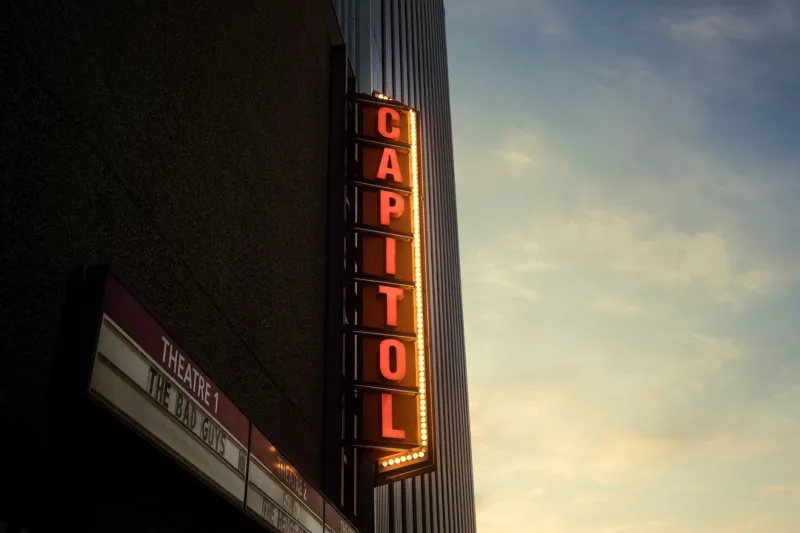
Liberty is the architectural showpiece of this crawl — an Art Deco hall from the late 1940s with a vertical sign that's been photographed more than most of the films it's shown. The building is the draw: curved lines, a soaring interior, that whole optimistic mid-century idea that a cinema should feel like a night out rather than a room with a screen.
Programming here leans toward Hindi and Marathi releases plus the occasional festival. Check the listings; when it's open, it's worth arranging your day around.
Regal Cinema, Colaba: the grande dame
Regal opened in the 1930s at the top of Colaba Causeway and has been through every phase a building can go through — glamour, decay, dark years, and a restoration that brought the Art Deco facade back to something close to its original swagger. It now operates more as an events and repertory venue than a nightly picture house, so treat it as a bonus stop: walk past it on the way to dinner and look up.
Gaiety and Galaxy, Bandra: the neighborhood double
Bandra's twin single screens are the closest thing to a neighborhood living room. Big Bollywood releases, queues out onto the sidewalk, and a concession counter that has been feeding this suburb for generations. Gaiety and Galaxy sit side by side, which makes for an easy double feature if you've got the stamina — or a good excuse for a long lunch in between.
How to eat the interval properly
Order in this sequence and you'll be fine. Samosa first, because the good batch goes in the first three minutes and the second batch is always a shade greasier. Ask for the green chutney; it's usually free and always better than the ketchup. Cutting chai second — a half glass, sweet, milky, and served hot enough to force you to slow down. Popcorn if you're still hungry, ideally the masala version. Kulfi on the way out, from the guy by the gate with the little metal mold.
Skip the nachos. There are nachos. Skip them anyway.
The seating vocabulary
Old Indian halls divide the house differently than American theaters. The stalls are ground level and cheapest — best crowd, worst sightlines if someone tall sits in front of you. The dress circle or balcony sits above and behind, costs more, and gives you the whole room to look at. In a hall with a screen this big, that upper view is its own pleasure: hundreds of heads, all leaning the same direction.
Etiquette, briefly
Phones on silent, but don't expect total darkness-and-silence reverence. People will react out loud. They'll cheer the hero's entrance, laugh at things that aren't jokes, and take calls at a volume you'll find startling. Nobody will shush them. Join in where it's welcome, keep your feet off the seat in front, and don't film the screen.
The time-capsule argument
There's a preservation case for these buildings, and plenty of people are making it. But the better argument is experiential. A multiplex is engineered to be identical anywhere on earth. A single screen in Dadar or Bandra is not — it's stucco and sweat and a specific audience on a specific Tuesday, and it costs about the price of a coffee back home.
So build the crawl around one matinee and one long interval. Get there early, look up at the ceiling, buy the samosa, and stay for the second half.